
Is Invisalign Worth the Cost Compared to Mail Order Clear Aligners?
Is Invisalign worth the cost over mail-order aligners? Learn the safety and hygiene differences, then schedule your consult at Nu Dentistry Richmond today!
Read More 
Cosmetic Dentistry, Teeth Straightening
Medically Reviewed by Dr. Ali Tameemi
Both braces and clear aligners straighten teeth effectively, but the right choice depends on the complexity of your bite, your lifestyle, and a factor most comparison guides skip entirely — how refinement phases and tooth-movement mechanics can quietly change your treatment timeline.
You've probably read that braces handle complex cases better. But what does complex actually mean?
For Richmond-area patients, the answer comes down to biomechanics. Braces attach brackets directly to each tooth, allowing an orthodontist to control movement at the center of a tooth's resistance — the point where force translates into precise root-level torque and bodily translation. Clear aligners, by contrast, apply pressure to the crown of the tooth. That distinction matters enormously for certain movements.
Vertical extrusion (pulling a tooth downward into proper position), severe rotation of back teeth, and significant root torque are all movements that plastic trays struggle to achieve predictably. A Healthline overview of aligners vs. braces notes that aligners cannot move severely crowded or malaligned teeth and are inappropriate for teeth with short crowns, which reduce the surface area the tray needs to grip and shift.
For patients with deep overbites, high canines, or significant sagittal discrepancies, orthodontists often turn to Temporary Anchorage Devices (TADs) — small titanium anchors placed in the jawbone that give brackets a fixed point to pull against. This level of three-dimensional control is simply not achievable with removable trays alone.
If your case involves jaw-level skeletal issues, WebMD's overview of invisible aligners notes that surgery is sometimes needed alongside orthodontic treatment — and that only recently have aligners become more common in these scenarios, handled by well-trained specialists.
The practical takeaway: mild-to-moderate crowding, spacing, and simple bite corrections are well within aligner capability. Severe rotations, significant overbites, and root-level corrections are where fixed appliances — or a combination approach — deliver more reliable outcomes.
Speed comparisons between braces and aligners almost always favor aligners. But those comparisons measure advertised treatment time, not actual treatment time.
Here's what gets left out: aligner "tracking loss." When teeth don't move exactly as the digital treatment plan predicted — due to minor non-compliance, difficult rotations, or tooth anatomy — the aligners stop fitting correctly. At that point, your provider takes new scans, a new aligner series is fabricated, and you wait for the new batch to arrive. That cycle is called a refinement phase, and it's extremely common.
A single refinement phase typically adds three to six months to treatment. Patients with moderate misalignment can go through two or more refinement cycles. To learn when refinements are needed with Invisalign trays, it helps to understand how tracking loss develops and what your provider looks for at each checkup. According to WebMD's braces resource, most people are in orthodontic treatment from one to three years — a range that applies equally to both modalities once refinements are factored in.
Braces, by contrast, are adjusted chairside at every appointment. When movement stalls, the orthodontist changes the wire or adjusts a bracket the same day. There is no fabrication wait, no new series to order. For moderate-to-severe misalignment, that real-time adjustability can make fixed braces genuinely faster on a net basis — even if the advertised timeline looks longer.
The honest question to ask your provider isn't "how long is the treatment?" It's "how many refinement phases should I expect, and what does that do to my actual finish date?"
The braces-vs.-aligners conversation is usually framed as a binary choice. It doesn't have to be.
Modern orthodontics increasingly uses a hybrid protocol: limited fixed appliances handle the mechanically demanding work first, then clear aligners complete the cosmetic finishing phase. A short course of sectional braces or a Carriere Motion appliance — typically three to six months — can correct severe bite discrepancies or sagittal problems that aligners struggle with. Once the bite is in the right position, the patient transitions to Invisalign for final alignment.
This approach gives patients the mechanical precision of fixed appliances where it counts, combined with the discretion and convenience of aligners for the visible finishing phase. It's not a workaround — it's a deliberate treatment design used by experienced providers for patients who fall between "simple aligner case" and "full two-year braces case."
Mouthhealthy.org from the American Dental Association points out that orthodontic treatment plans vary based on your situation, and that the severity of your case determines which approach — or combination — produces the best results.
Adults in particular benefit from this conversation. WebMD notes on clear aligners for adults that one in three orthodontic patients is an adult, and that pre-existing dental conditions can make the realignment process more involved — which is exactly where a hybrid plan adds value.
Beyond mechanics and timelines, daily experience shapes which option actually works for you.
Clear aligners are removable, making brushing and flossing straightforward. They're smooth and don't carry the risk of bracket-related soft tissue irritation. Braces require more deliberate oral hygiene — food restrictions, floss threaders, and careful cleaning around brackets. Healthline's aligner guide emphasizes that aligners require genuine commitment: wearing them the recommended 22 hours per day is non-negotiable for the treatment to work.
That compliance requirement is where some patients underestimate aligners. A patient who frequently removes their trays — for meals, social situations, discomfort — will see their treatment plan drift. With braces, the appliance works continuously because it cannot be removed. Patients considering lingual braces treatment should know this fixed-appliance advantage applies there as well, since lingual brackets work around the clock without any compliance requirement.
Neither option is universally superior. As one orthodontic specialist quoted by WebMD puts it, both tools serve as a means of applying force to the tooth, and teeth only respond to that force. What differs is how that force is delivered, controlled, and maintained across your specific tooth movements.
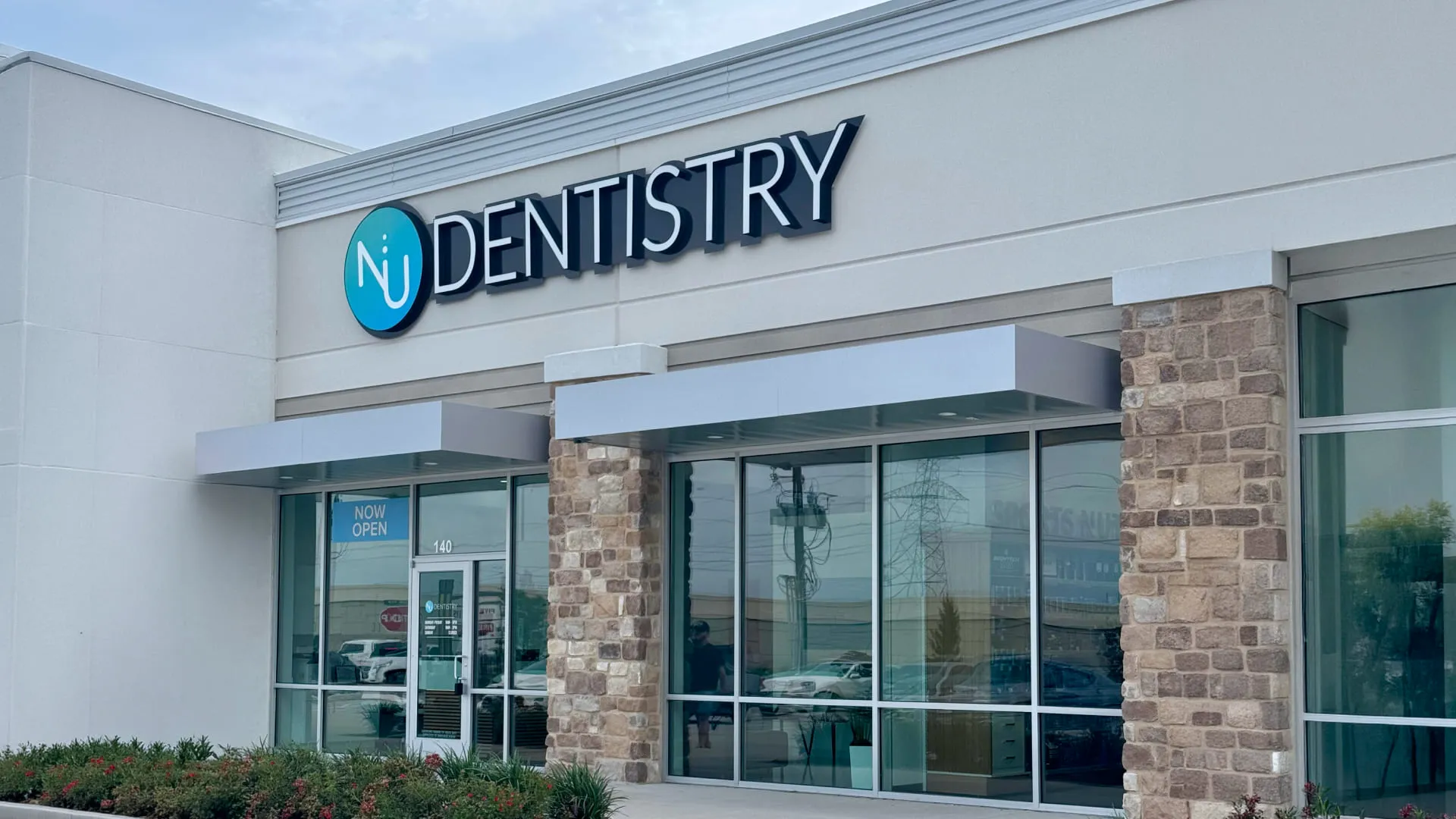
If you're weighing aligners against braces — or wondering whether a hybrid approach might make more sense for your bite — Nu Dentistry Richmond is here to help. Our Richmond, Texas team can walk you through your options based on your specific case, not a generic comparison chart. Schedule a consultation and get a clear picture of what your smile journey actually looks like. Check out our current dental offer to get started with savings on your first visit.
Medical disclaimer: This article is intended for informational purposes only and does not constitute professional dental or medical advice. Always consult a licensed dental professional for diagnosis and treatment recommendations specific to your situation.




Tuesday 9-6pm
Thursday 9-6pm
Saturday 9-2pm
11115 W Grand Parkway S, Suite 140, Richmond, TX 77407
5706 San Felipe St Ste B-300, Houston, TX 77057
23227 Gosling Rd., Suite B, Spring, TX 77389
8940 Barker Cypress Rd., Cypress, TX 77433
3201 N. Shepherd Dr. Suite 113, Houston, TX 77018
8145 Highway 6, Building B #200, Missouri City, TX 77459
PATIENT TESTIMONIALS Richmond, TX
What People Are Saying After Visiting Us


CARING DENTISTS Richmond, TX
OUR SOCIALS
Check Us Out and Follow Our Social Media Accounts